The Beauty of Anachronism

A month ago, I suffered a serious setback in my personal life, as a year-long relationship came to an abrupt and unexpected end.

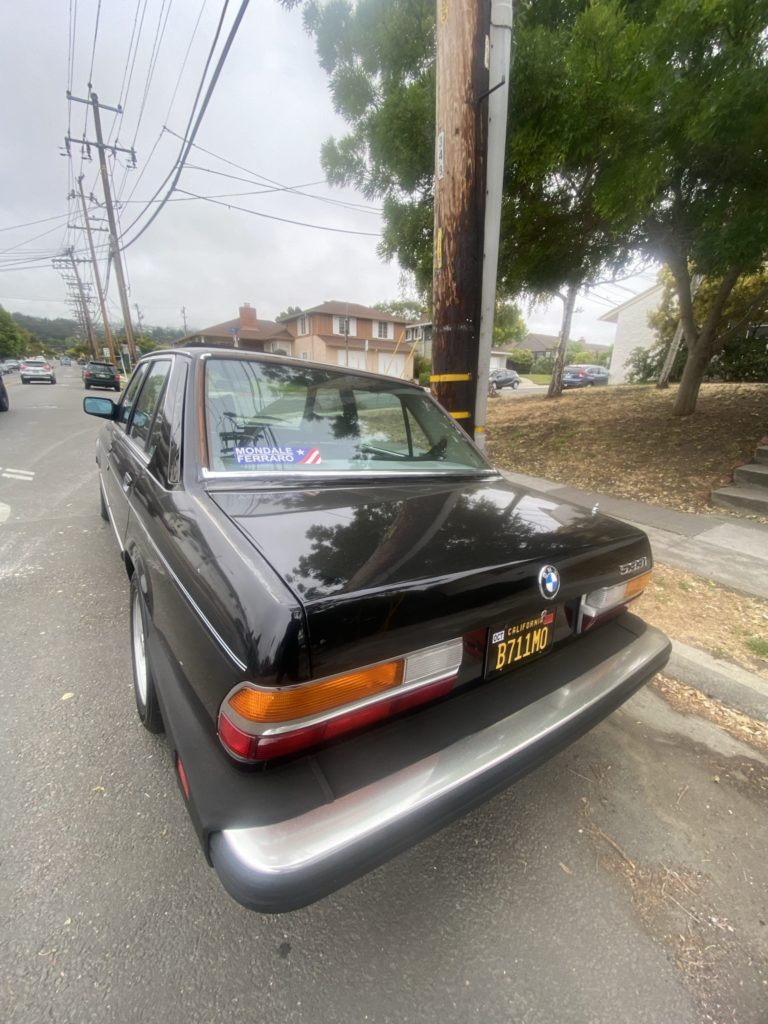
Today, on a morning walk, my heart still heavy with grief, I passed this lovely anachronism, and it set me to thinking more broadly about defeat, and loss.

This was the 1984 election. After the 1980 debacle, many of us hadn’t accepted “there is no alternative” to Reaganism and Thatcherism. We held out hope that white working-class people, led by women, would return to the Democratic fold and re-establish the New Deal consensus that had been fractured by the Vietnam war and the social upheaval of the 60s.

The election results crushed those hopes, as the GOP’s tax cuts and deficit spending powered a well-timed economic boom, and whites of all classes responded enthusiastically to the President’s anti-intellectualism and race baiting.

Time goes in only one direction. As time does its awful work, we can be helped, at least a little, if we open to the present moment, and feel the humor that resides in what is. Relaxing the mind, we might come to awareness of how little we know about what comes next.

Amongst progressives, most of us were completely wrong, back in 1984, about how our country might move forward. We couldn’t foresee the halting progress under Clinton nor the deep cynicism and criminality under Bush II. But most of all, we couldn’t foresee the flowering of freedom as one barrier after another came down—nor the deliberate organization of the present fascist movement in response to that freedom.

The other night I got together with my friend and co-parent Melanie Mintz, and we watched Saturday Night Fever (1977). We thought we’d vet it before offering it as entertainment for our 12-year-old daughter. Watching scene after scene, we howled with laughter at how inappropriate that would be. After 34 years, we’d forgotten almost everything that’s in the movie, except the dancing. The stereotypes. The racism. The debasement of the female characters. The darkness and cruelty and hopelessness in every aspect of the characters’ lives.

All that didn’t seem so extraordinary or so awful when the movie first came out. Now it does, and I am so happy and amazed to look at the change.

We didn’t get what we wanted in the 1984 election, and we were at a loss about how to move our national politics forward. But the country did move forward—stunningly, in retrospect—toward a kinder and more decent society, and the politics have moved and continue to move with it.

I’m still plenty scared by the fascists trying to undermine democracy. And I’m still really sad about losing that relationship. But I’m buoyed by my renewed awareness of how waves of change carry us onward—despite grief, despite loss, and despite hope.

People v. Hansen

I served on a jury 35 years ago, in New York City. The defendants were white cops, and a Black man had died in their custody.

The cops were charged with evidence tampering and official misconduct, and we voted unanimously to convict each of them for both felonies.

Many years later, I searched for the case, and found the appellate court record. I wasn’t surprised to see the conviction overturned–because I believed then, and believe now, that the whole criminal justice system is set up to protect cops who violate the law and abuse their public duty. Even so, I was upset by the appellate judges’ rationale.

The case was cut-and-dried. The patrolman, Hansen, had admitted the facts before a grand jury. There was some wrangling over whether we could receive the grand jury records, and once that was resolved, the case was closed, in my view. We spent some time deliberating over whether Hansen–who watched Compas, his supervisor, hide a shoelace that matched the ligature mark on Leonard Jones’ neck–had tampered with evidence simply by keeping his mouth shut about what he’d seen. Once that was resolved, we were ready to report our verdict.

The trial was plenty dramatic, though. The night Leonard Jones died, Compas and Hansen called their captain at home. Compas had just taken an internal exam and was freaked that this would screw up his chances for a promotion. So he was lying his ass off to the captain, and when the captain testified in court, he was still incensed about it. Maybe even more so because Compas accidentally left the phone of the hook after the call and inadvertently recorded himself and the other on-duty cops getting their phony story straight.

It turned out that the Assistant DA had flipped Hansen only after suggesting that the ligature mark on Leonard Jones’ neck matched the leather strap on Hansen’s nightstick. Then Hansen suddenly remembered about the shoelace.

And I thoroughly remember the Assistant DA’s summation. It was passionate, stirring, beautiful to see. However, it didn’t have any effect on our deliberations, which were entirely about “proper construction of the statute.” The appellate court concurred, essentially, with what we figured out in the jury room.

Here’s what pisses me off: The appellate court judges could see, as clearly as the jurors, that the facts of the case were cut-and-dried and the jury had no choice but to convict. No choice–unless, of course, we allowed ourselves to be swayed by the defense lawyer’s argument that the cops were really good guys just trying to do their jobs. In other words, we jurors should overturn the case the DA built based on the facts, because juries should support incompetent and dishonest cops just because they are cops. We didn’t do that, because–as we agreed unanimously after deliberating there in the jury room–it would be wrong to do so.

What I remember most clearly, all these years later, is the Assistant DA looking at us earnestly and saying, just as is recited in the appellate court’s decision:

“After all, who is Leonard Jones? He is just some skel, so nobody cares about him. So it is OK to cover up what happened to him. So his family has no right to know the circumstances of his death.” “[Defendants] don’t care what right the public has to know about a prisoner’s death in police custody, and [defendants] don’t care about Leonard Jones’ family’s right to know.” “It’s just Leonard Jones, it is just some skel, just some bum from the Port Authority. What difference does it make?”

The appellate judges Kupferman, Asch, Rosenberger, Ellerin, and Smith should have known, or maybe did know, that the Assistant DA wasn’t talking just about the cops, she was talking about the whole damned system, including them.

Painful, Part 3

On Thursday, 26 days after the surgery, I went to Kaiser Oakland to get the cast removed. I drove the F-150–it’s got an automatic transmission, so I can drive with just my right hand. And who uses turn signals anyway. I parked on a nearby residential street and walked under the freeway and past the tire shops.

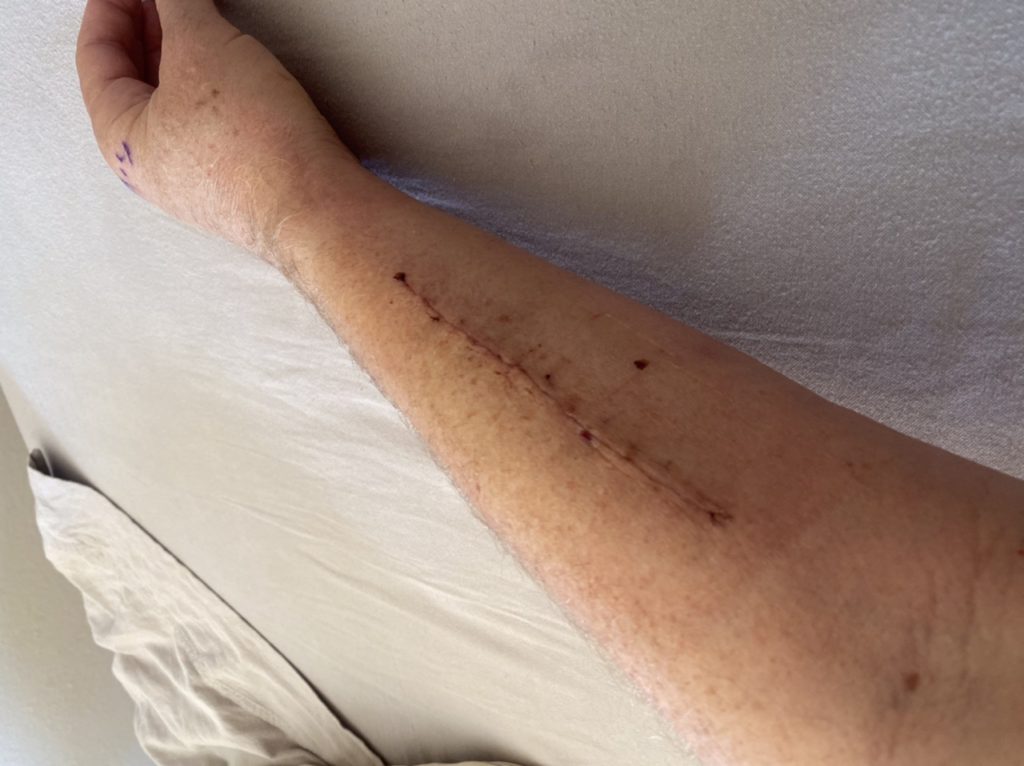
I’d been looking forward to the feeling of the technician’s saw cutting the length of it, to the release of the pressure. The relief was good, but not quite what I’d hoped. The forearm looked like a newly shelled shrimp, and felt as raw and amorphously numb. Free, but useless for now.

And just as painful. I‘d thought the pressure from the arm swelling into the confines of the cast was the main cause of the pain, but the rough sores and the rawness of the skin were still hot and sharp. The surgical scars, six inches on the side aligned with the thumb, and another equally long aligned with the pinky finger, sang their sensation brightly with the novel cool air.

And I could feel the fascia, under the skin, stiff and turgid, painful to the touch, and unyielding whenever I tried, with little success, to rotate the forearm, or make a fist, or even droop my wrist.

Life is suffering.

“You can go ahead and use it, lift things,” said the P.A. I asked her to renew my scrip for Dialudid.

Which I haven’t used since, but still might. That morning, I’d awoken with an unexplained headache and nausea so intense I wasn’t sure I could make the appointment. Food poisoning? Sudden onset of severe sinusitis? A little later in the day, I thought about the Dialudid again, and a felt a physical revulsion.

Oh, so that’s it. I’ve been taking this stuff at bedtime, and sometimes again in the middle of the night, for a few weeks now, and my body and brain don’t want any more. I’d had the chronic constipation, and then the persistently runny nose, just like any other junkie. But now it was like I was going to finish with my works and then go vomit in the bushes, just like I’d seen guys do back on the streets of New York.

It didn’t stop there, either. My meditation practice was oddly thrown back, to the time before I felt my self inside myself. These last many sessions I was no longer turning toward that entity; no longer soothing it, or playing with it, or watching it dissolve. Instead, I was just kind of drifting on the cloud.

Life is suffering.

Four weeks ago, as I lay on the pavement, breathing into the pain, waiting for the ambulance, I promised myself I’d stay open to the lessons of this experience. Later, I shared this intention with my muse and sensei, and she kind of went off on how accidents can just be accidents, they are not there to teach lessons. I get that. Still, I honor my intention. Accepting impermanence is hard, and the difficult times in our lives can be gateways to a greater understanding.

Painful, Part 2

Kyle explained it to me.

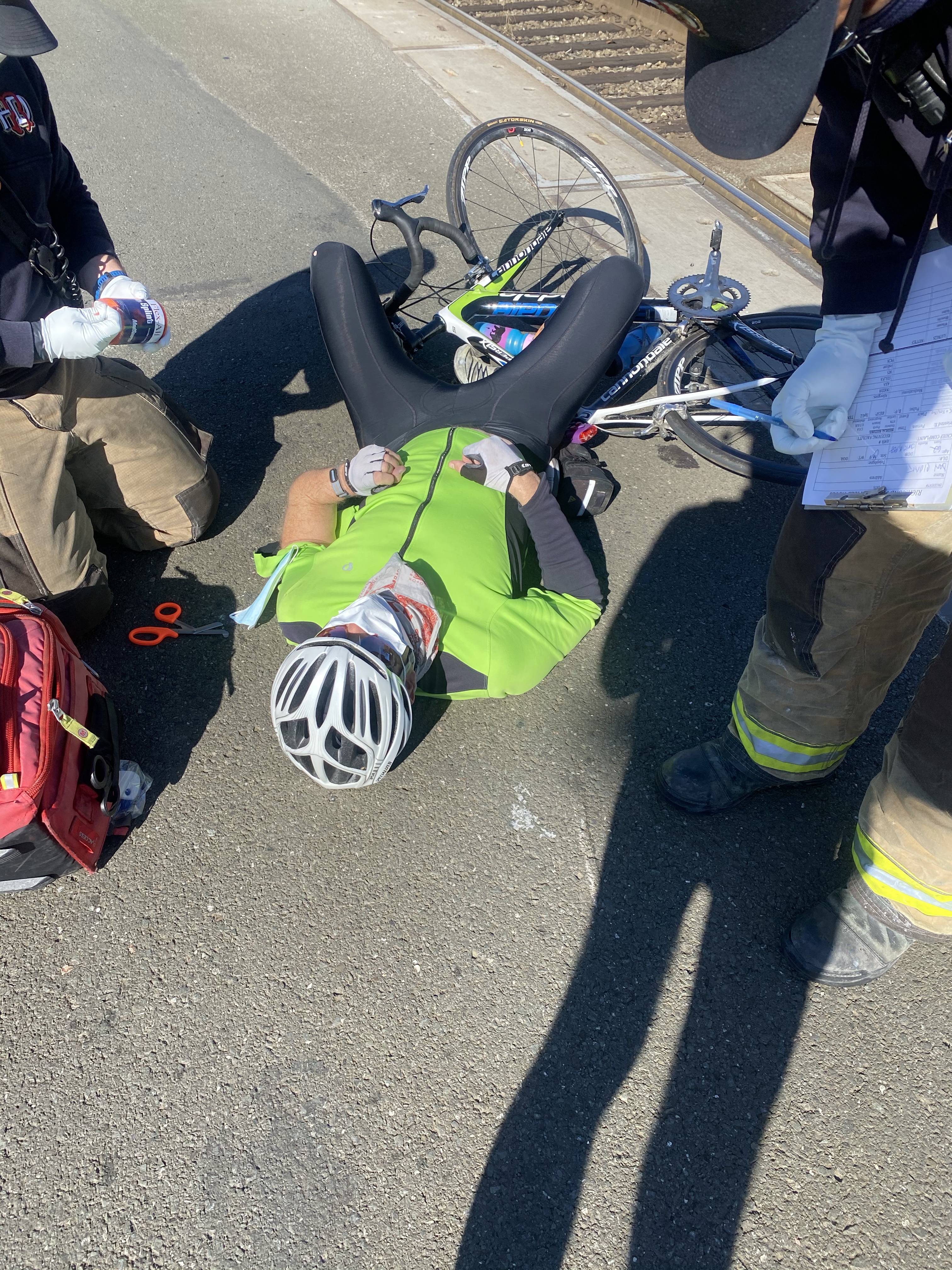
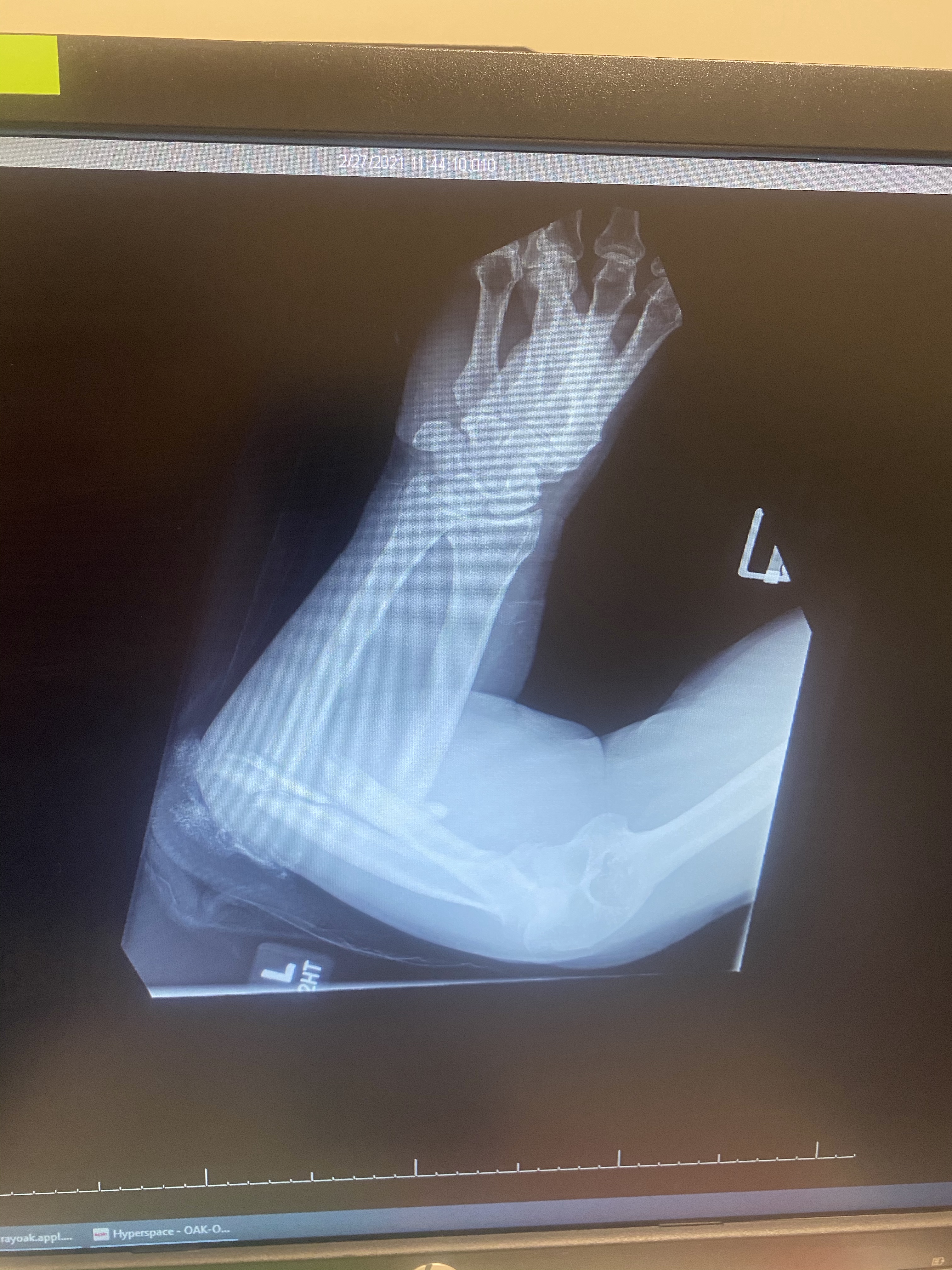
As I lay face up, my back pressing against the pavement, waiting for the ambulance to come, my left arm began to curl into itself, bending at the place where the bones were snapped. In a few minutes, the bend came to 90 degrees, as if I had a second elbow.

I’d felt the curled, bleeding mass cradled against my ribs as I crawled on to the gurney.

Since then, pain has stayed about the same, sometimes more intense, sometimes dulled by drugs, but always feeling like a tightening, a pulling inward, a curling up.

Life is suffering. On the pavement, in the ambulance, and in the ER, I pondered my lesson. In the evening, after the surgery, I sat in my room—alone, in the dark, with a high-floor moonlit view of downtown Oakland.

The pain has been a constant companion, and I’ve accepted the pain, with help from some powerful opioids. After a day or two, the shock and the initial arsenal of drugs I’d received—Fentanyl, morphine, ketamine—wore off. I contacted the surgeon.

The fixing itself was, and is, a miracle. In the hospital, I was pleased by the surgeon’s bored demeanor. This is what you want in such situations, right? His team looked like they’d been bolting bones back together all damned day, and countless days before that. Somehow they sliced my arm open, moving aside arteries and nerves to dig down to the bones, then aligned the titanium plates on each, got enough screws in, and closed the arm up against invading bacteria.

Uncurled.

Which is, I think, part of the discomfiting feeling that goes along with the pain. I still have that wanting to curl up, to protect, but the arm is fixed straight, first by plates and now by a plaster cast, too. And it hangs off my shoulder like an alien. My fingers, emerging from the end of the cast, are painful and barely usable reminders of what was.

Life is suffering. I could accept the pain. I told the surgeon I couldn’t take the hydrocodone. I got him to upgrade so I could renew my expired stash of oxycodone, but after a few days, I was damned if I’d take that either. Both are really crappy drugs; both will, after a brief period of use, put me in state where I don’t know who I am or what I’m doing. I don’t know who else they affect that way.

The hydromorphone is much better, but 19 days now since the injury, I split my time between the pain—while working and caregiving—and drifting on the morphine cloud. I’m usually damned ready for a pill by 5 pm, if I haven’t already had one by then.

Life is suffering. I think the hundreds of hours I’ve spent meditating over the past few years has helped me cope with the pain and to function despite the pain and disability.

I don’t think I’ve learned my lesson, yet, though. I’ve spent some hours contemplating these new feelings of advancing age and frailty. I’ve let go some self-expectations. I’ve gently mocked myself for trying to do things I shouldn’t try to do. I’ve confronted myself for not taking time for needed self-care, and recognized that habit is part of holding on to past trauma. And I’ve also, just yesterday, dealt with my kid being defiant and melting down while simultaneously attending a Zoom meeting on one screen and writing a letter on deadline on the other. With my throbbing left arm elevated above my shoulder.

Today I finished some morning business and put on my rain gear before heading out the door on a walk, up through the City’s Hillside Natural Area, climbing above the cliff behind the old quarry, then through the residential neighborhood that straddles Arlington Avenue, where I admired the big mid-century houses, then down to Wildcat Creek, the rain beating down and turning the road into a slippery muddy morass, with my cast in a sling and my hand tucked into the pocket of the rain parka, emerging by Jewel Lake and the Little Farm, and talking with the client on my phone as I descended through Kensington and the Sunset View Cemetery.

I walked back in the door in time to strip off my wet gear and put on a blue button-down before joining a meeting with the managers of some of our local cities and towns.

An hour later, a bit chilled and shivering, I crawled into bed, watching the rain come down outside the window and feeling my forearm, up on pillows, shrink until it was no longer pressing tight against the cast. I felt at peace as drifted off to sleep in the waning afternoon light.

Painful, Part 1

Now two weeks into recovery, I am, for the first time, attempting to keyboard and feeling ready to tell the story.

I’d estimate that, since taking up road biking in 2008, I’ve rolled at least 40,000 miles. The only mishaps have been encounters with drivers who chose to pull across the double yellow line directly into my path, suddenly and without warning–one in 2009 and another in 2012. Otherwise, despite the obvious hazards of the sport, I’ve been unscathed.

No longer.

What’s more, I am a far-from-cautious cyclist. On the urban arterials, I’ll challenge cars for right of way. On winding mountain roads, I’ll enjoy the thrill of a fast descent.

However, on February 27th, I was doing just what any kid or adult might do when taking a spin around the neighborhood–just riding along at an easy pace in the company of friends. In other words, this could’ve happened to anyone on a bike.

I do have a woulda coulda shoulda about it, though. The trauma probably affects my memory, but I do seem to remember thinking, oh, railroad tracks, they look like a hazard, angled 45 degrees across the roadway like that, but they’re not really, because you can just roll right across…

Except this time I didn’t. I distinctly recall the unexpected tug on the handlebars, and looking down at my front tire wedged alongside the iron rail, and heading at terrifying speed for the pavement.

And the sharp crack of the bones in my forearm breaking.

I didn’t hit my head or lose consciousness or anything. I think I was mentally calling for 911 before my body came fully to rest.

Because I wanted everything to be as calm and routine as possible. I wanted to be in that ambulance on the way to the hospital with no damned chaos or excitement and delay before I got there.

For the most part, I got what I wanted. Randy and Kyle were shocked and asking me questions, but a passerby said he’d already made the call. Then, somewhere behind my head, on the other side of the tracks, some lady angel had stopped, was making calls, bringing me a mask–mine was still in my jersey pocket–offering to come back with a truck to pick up my bike, making sure BNSF was told to stop the trains. I focused on breathing–in, then out– and moaning just as much as I needed to, and no more.

I heard the sweet sound of a siren in the distance. They were coming for me.

Yeah, I knew my name, and DOB, and the year. I was amused that they didn’t ask me the standard question of who’s the President. Too loaded, I guess.

The arm was kind of a problem. There was no way to get a splint on it, bent as it was. Eventually the EMTs just wrapped it loosely in gauze. I stopped them from trying to lift me. I could roll onto my good side while I cradled the arm against my body, and then I could walk on my knees to where I could swing my butt on to the gurney. From there it was a cinch for them to load the crumpled mess through the bay doors.

Inside, the paramedic was unwrapping supplies and hooking me up to the monitors. I was asking for the pain meds. It wasn’t long before she had a 20 gauge IV in my arm and 100 mcg of Fentanyl on its way.

It wasn’t near enough, but we got to Kaiser’s Oakland ER anyway.

From there, the care was attentive, professional, reassuring. They gave me a solid IV dose of ketamine while they put the arm back straight and plenty morphine as I whiled away the afternoon hours. And then it was time for surgery.

Yes, ouch

I come to praise 2020

as well as to bury it.

2019 was exceptionally tough for me, personally. My household broke up, and my mom committed suicide, and my main work client succumbed to chaos for a time. I had flood cleanup and repairs to do at the river house, and an evacuation during fire season. It seemed like one damn thing after another all year.

But 2020?

Mostly, I feel badly for my kid, and all kids who lost nearly a year of their childhood to the lockdown, and are still losing. And of course I feel badly for people who got sick, or died, and for the people who took care of them, all the time being ill-led and poorly resourced.

Ever since reading Laurie Garrett’s The Coming Plague, back in the ‘90s, I’ve known a pandemic was coming. This disease, this pandemic? It’s still in progress.

So far there are many silver linings.

First silver lining: It happened on Donald Trump’s watch, and drove his incompetent and corrupt presidency into the realm of the ridiculous–and contributed to his defeat. Remember, in the wake of the 2016 election, we actually had some people,–even sober and well-intentioned people–saying GOP supporters were just ill-informed, or economically anxious. This time around it’s clear that Trump is (and was) a convenient focus (not even a leader, really) for an ongoing, broad-based fascist movement rooted in the masses of uneducated white people.

We are polarized, to be sure. Is it a bad thing that so many progressive Americans finally, in 2020, woke up to that?

The Bernie-Sanders-and-leftward left, which seemed kind of resurgent in 2016, and carried some momentum through to the 2020 primaries, has now–by the hand of its own arrogance and cluelessness–made itself practically irrelevant.

In its place, there is an upsurge in political participation–an upsurge that is most urgently anti-fascist and pro-democratic, but also includes new discussion and debate about the country’s history, about whiteness, and about capitalist economics. Many now expect and anticipate radical change, and foresee that change coming over years, via existing democratic structures. Many self-defeating shibboleths–it’s the corporations, it’s the electoral college, it’s money in politics, it’s Fox News–have given way to the realization that American conservatism and resistance to change is rooted in white supremacy, and the scale and nature of our battle is more akin to the American Civil War than to the revolution of 1848 (in Europe), or to the labor movement of the 1880s through the 1930s here, or to the 1960s social upheaval.

The movement for Black lives–at its height over the summer–revealed the potency of this upsurge, not just because the demonstrations were widespread and persistent, but more importantly, because attention was soon directed to demands that are specific, achievable, and far reaching. The Democratic Party, acknowledging its African-American base, embraced that movement. Progressives, who have in the past dallied with “critical support” (or half-hearted support) for the Democratic Party, were required to take a side. All to the good.

As a second silver lining, the response to the pandemic is a dress rehearsal for the required response to climate change: Massive, rapid change is necessary. Trillions must be spent. Competent government is required, or the entire population suffers. A majority (or at least a near-majority, and headed in the right direction) accepts this.

There are other silver linings: Expressions of anti-scientific prejudice now get, in 2020, howls of derision and not merely tut-tuts. There is, to my perception, a marked abating of the “personal solution” attitude that came in to vogue in the early 1970s and has persisted throughout my time. The same goes for various forms of reactionary nostalgia, or the idea that “technology won’t save us” (then what, pray tell, will?).

So overall, I find the country’s political and social milieu much improved over where it was a year ago.

As for my personal situation, as in the past few years, not everything went right, but the things that I did–where I took action–not only turned out mostly right, but were if anything aided by the extraordinary situation of the pandemic. I got a new solar roof on my house, and the house painted, and am happy with the result. In the middle of the year, I signed a new contract to continue assisting my main client.

Around the same time, while dating under pandemic restrictions, I found a great new love relationship.

With no Club rides, and no commuting to the barber or therapist, my mileage on the bike was way down (2,343 miles from 3,660) but I kept it up consistently.

I meditated 20 minutes on each of 364 days during the year.
A brief for a troll

Has there ever been a time when one’s facility for dividing truth from BS has been more needed–and yet more difficult to do? My daily sorting through spam exercises it; my news aggregator and Facebook challenge it even more.
The deliberate lying and misleading–in the service of taking your money or infecting your computer, or obtaining your political support–is annoying, even painful, and it’s all too easy to just hate on it.
At the same time, I think we all admire, secretly or not, a good prank or hoax, when it’s funny and it’s especially when it’s directed at someone, or many someones, whose beliefs and behavior are over the top.
And I’ve done it from time to time myself, but never as effectively as this guy.

Andy Gill

My 7th grade band teacher, Mr. Preble, was a slim and elegant man. In retrospect, I can see that he was enormously patient, and we tested that patience considerably.

I liked him right up until the time he made a comparison–a comparison I found insufferably arrogant–between the pop music we liked and the classical music he wanted to teach us about. His point, as I recall, was that while pop music was almost invariably about young romance, classical music evoked a refined and subtle reflection on many aspects of the human experience…

I interrupted him there, and not politely. “It depends on what you listen to,” I said. “Pop songs are about all kinds of things.” Mr. Preble and I couldn’t be friends after that.

If my objection was true in 1969, it was even more true a decade later. While I like a love song or a broken-hearted song as much as the next fan, I was still hanging on to my conviction that there were more important and revolutionary things to be found in lyrics and liner notes and in the rhythm and noise. Something is happening here, but you don’t what it is, do you Mr. Jones?

So in the late 70s I found myself defending my view all over again, this time with older colleagues in my Marxist-Leninist collective. Their tastes had moved on from their early appreciation of Dylan and the Beatles and the Stones, and had ended up in that 1970s place where one’s music was no longer an expression of alienation or revolt but had become mellow background for getting an after-work Rocky Mountain High– which is to say, it could be about romance, or not about romance, but it really didn’t need to be about anything at all.

And then, amazingly, the alienation and revolt came back to rock ‘n roll, this time fueled by Thatcherism. I loved the Sex Pistols and the Clash and most of all I loved the Gang of Four, whose music had things to say about social theory that were considerably more profound (and profoundly Marxist) than what I was getting from the collective’s study group.

Some young hangers-on recruited me into a Marxist-Leninist wannabe punk rock band–we called ourselves the Prols–and I learned how to play drums, sort of. One night Ricky, our leader and guitarist, told us Gang of Four was going to be playing at Hurrahs and we were all going together.

Which brings me to this article by Sasha Frere-Jones in the current New Yorker. She gets the Gang of Four’s contributions to the funk/punk genre mostly right, I think, and she includes a vignette from that show, along with a link to omigod, video:

When Gang of Four came to New York in 1979 and performed at Hurrah, they did a version of “Damaged Goods,” which was already enough of an underground hit that the audience sang along to most of it.

Well, we were singing along to it, all of our bandmembers there in the mosh pit, because we wanted to make that sound and sensibility part of our own. Besides, the lyrics could have been written about my unrequited love for the girl I’d followed out to New York two years earlier:

Damaged goods
Send them back
I can’t work, I can’t achieve
Send me back
Open the till
Give me the change you said would do me good
Refund the cost
You said you’re cheap but you’re too much

Which of course actually is about young romance, but what Mr. Preble wasn’t getting about rock ‘n roll is that it’s always all about young romance, but it’s also about rage and alienation and a burning desire to turn the world upside down. When it’s not about some other aspect of human experience.
Or as the Gang of Four’s lyricist, Jon King, put it in a slightly later song, “Why Theory

Each day seems like a natural fact.
And what we think, changes how we act.

The Gang of Four’s leader and guitarist, Andy Gill, died Feb. 2 of pneumonia. He was just three years older than me.

Zuckerman asks for regulation

This news less surprising than it looks.

“Regulatory capture” isn’t just about avoiding regulation entirely; more often, it is a way that industry leaders (and occasionally, savvy upstarts) tailor entry requirements to give their own business an advantage over their competitors.

This can go either way, and the same business may find it to their economic advantage to lobby for more or less or different regulations in different times and different circumstances.

My guess is that that Facebook’s main concern is that the EU regs align with their own plans and innovations and not those of current or potential competitors.

Savvy regulators can use that competition to the public’s benefit, by lining up support from companies that stand to gain from needed regulatory initiatives.

Programs and Purposes

I’ve been preparing comments and ideas and proposals for the up-for-reissuance San Francisco Bay Municipal Regional Stormwater NPDES Permit, and for the statewide NPDES permit covering small municipalities.

NPDES permits are issued for 5 years, and this is, by my count, my fifth go-round.

Here’s a challenge: Can anyone involved describe, in a few words, what these permits are intended to do?

Because in their written expression, and in the programs that implement them, you’ll find a bunch of intents and purposes and mandated actions–all kind of cobbled together. Trying to piece it together is like digging into a closet where stuff has been accumulating for decades. Every part has a story, but there’s no unifying theme.

I do trainings and presentations, mostly on implementing the land development requirements of the various permits. At the beginning of each presentation, I implore the trainees to bring their own purpose, and their own creative energy, to the task at hand. The permits give us a mandate and authorization, I tell them, but it takes creativity and personal engagement to achieve something useful for our local communities.

For a land development project, that creativity has expression in the grading, drainage, and landscaping, and in the placement of bioretention facilities in relationship to the buildings and pavement. At its best, the result solves many problems with simple strokes–that is, elegant design.

I want to bring that same lesson, and that same aspiration, to the jumbled, overstuffed permits I’m now commenting on. What is the unifying theme that could make sense of the mess? And how could that result in more meaningful, creative programs going forward?

Picking through the accumulation of decades… there’s the problem of dumping and illicit discharges, and enforcement against the dumpers, and inspections of commercial/industrial facilities, and public education about preventing discharges, and then public education about use of products like pesticides, and then public education about watersheds, and their function and value, and then, for while, actual attempts at watershed management, and then seeing those attempts subsumed by the demands of implementing load reductions for specific pollutants (like heavy metals, and PCBs), and then mandates to eliminate trash, and now, retrofitting streets and drainage infrastructure to mimic natural drainage.

The unifying theme, and the opportunity, I see here is: “Changing our relationship to drainage.” Each of the parts, each of the permit mandates, and each piece of the shared history of local stormwater program implementation, connects in some way to that idea.

In a future post, I’ll apply that idea to assessing some of the successes and failures of stormwater programs, and to where they might go next.