Something is happening here and you don’t know what it is, do you David Brooks?

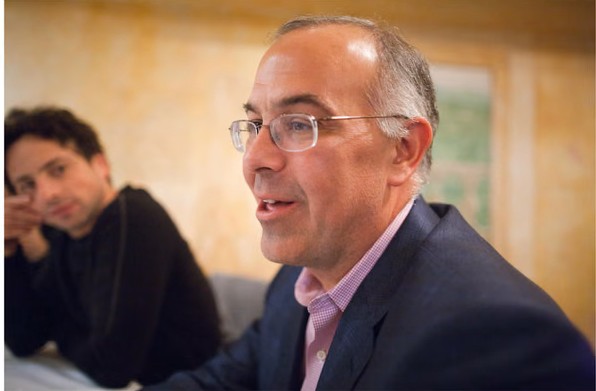
David Brooks enjoying Jeffrey Epstein’s largesse.

The Guardian reports that David Brooks was at a Epstein party in 2011—three years after Epstein pled guilty to soliciting a minor.

This is dog-bites-man. Not news. Is there really anyone out there who expected any more from David Brooks as a human being?

Brooks’ employer, the New York Times, defends Brooks:

“As a journalist, David Brooks regularly attends events to speak with noted and important business leaders to inform his columns, which is exactly what happened at this 2011 event,” a Times spokeswoman said. “Mr Brooks had no contact with him before or after this single attendance at a widely-attended dinner.”

Which is a diversion, because again, the story here is not about Brooks cozying up with a felonious pervert.

The story is this:

Brooks is just doing what the New York Times pays Brooks to do, which is to cleverly defend the Epstein class, week in and week out. 

How does Brooks do this so well? Here’s a sample from his column in the Times just last month.

“Why is Epstein the top issue in American life right now? Well, in an age in which more and more people get their news from short videos, if you’re in politics, the media or online it pays to focus on topics that are salacious, are easy to understand and allow you to offer self-confident opinions with no actual knowledge.”

Brooks goes on to say that Democrats highlighting the Epstein story are “undermining public trust and sowing public cynicism…”

Never mind the cynicism of normalizing Epstein’s behavior.

That powerful men manipulating and assault young women, and get away with it, is not what the Epstein story is about. I grew up in the 1970s. The teenaged women I knew were under constant sexual coercion and assault by their bosses, whether the bosses were greasy-spoon restaurant owners or criminal defense attorneys. I have a 16 year old daughter now, and I’d like to think it’s better today. In any case, this persistent everyday horror is not exactly national news.

The reason the Epstein story resonates is because David Brooks and his high-falutin’ intellectual class don’t get the Epstein story.

David Brooks has deeply internalized the privilege of the ultra-wealthy. In doing so his mind unconsciously and consciously categorizes the world into two groups, the one group being the Jeffrey Epsteins and the Sergey Brins, people who are credited with feelings and agency, and the other group, the rest of humanity—you and me—who are objects to be used.

Because David Brooks identifies so powerfully with his wealthy hosts, he cannot fathom that this is offensive to us. He can’t see that the casual treatment of human beings as objects—not the salaciousness—is why we want to see him and everyone else associated with Jeffrey Epstein exposed.

Upton Sinclair wrote:

“It is difficult to get a man to understand something when his salary depends upon his not understanding it.”

Brooks’ salary depends on his not understanding what we know about the fount of human decency. To keep his salary, Brooks must draw a conspicuous mental blank whenever principle conflicts with his assignment to protect capital. 

It’s best for Brooks that he doesn’t understand, because not understanding makes it easier for him to spin his illusion—the capital-serving illusion that informs all his work—that democracy and human rights are all about adherence to social norms, rather than about who has power over whom.

We know better. We know that David Brooks is a clever intellectual stooge for the ultra-wealthy class. He got a little too close, and a little too clueless, and showed the world who he is.

MAGA and Mamdani

About last night’s election results, my mind holds two different narratives.

For those who haven’t followed: Democrats racked up wide margins for Virginia and New Jersey governor. Democratic socialist Zohran Mamdani won NYC mayor with huge turnout and 75% of the youth vote. Gavin Newsom’s Proposition 50 won 64-36 in California. Down-ballot, Democrats won statewide and local races in Georgia, Pennsylvania, and elsewhere by wide margins.

One narrative is that MAGA without Trump fails. This narrative echoes how many of us felt before the 2016 election. In that time, the “Obama coalition” of liberalizing white suburbanites, Black people, Latinos, and Asians was chipping away at—and promised to eventually overwhelm—the GOP “Southern strategy” coalition of businessmen and rural racists. Trump’s shocking 2016 win upended that view, but it was never clear whether, or to what extent, Trump’s base was a dangerous expansion of the 2010 Tea Party racist backlash, or simply an allegiance to one singular faux-populist strongman.

With the 2024 election, that puzzle became more complicated: The GOP made huge inroads with Latino voters. There was a solid shift to the right nationwide, and a devastating shift in heavily Latino counties.

But again, it wasn’t clear whether this was simply and solely about Trump.

Comparing last night’s results to last year’s election, it seems that—without Trump on the ballot—county-by-county voting patterns bounced back to the pattern that favors the Obama coalition. Latino counties went back to being reliably Democratic. Educated “independent” suburbanites hedged their support for local MAGA candidates.

This pattern bodes well for 2026 and 2028. It supports the narrative that MAGA without Trump fails. It supports the idea that the underlying progressive-centrist coalition—the coalition that passed the American Rescue Plan Act, the Infrastructure Investment and Jobs Act, the CHIPS and Science Act, and the Inflation Reduction Act, the coalition that restored the Paris Agreement and established Juneteenth—is intact. Trump is done as a candidate. Once we get back in power, these important changes to government and economy can be restored and expanded.

(Many on the left exclude themselves from this Democratic coalition—they are strangely uninterested in equality, the climate crisis, child poverty, and health care access whenever these issues are effectively addressed by Democrats in power.)

The other narrative is that of generational change and activism. Young people are embracing the idea that life under capitalism is mostly crappy and the purpose of government is to make it less crappy by providing economic security and universal human rights. Mamdani carried that message and won with it, won by a large margin. I have the feeling that educated independent suburbanites weren’t really with him. He benefited from having a truly loathsome opponent. I doubt the strategy that just won in NYC will travel well.

At the same time, Mamdani’s brand of democratic socialism is exactly where we need to go to address the multiple crises engendered by an economic system that becomes more outdated and more inhuman with each passing day. Right-wingers and many self-styled “centrists” are excoriating New Yorkers for electing him. They have reason to do so. Once working people see how much better life is with fast and free busses, free childcare, and rent freezes, there may be no end to what they demand from capital.

Dan is the Man in the Van

I’m working on a memoir, which is the “culminating experience” of 4-years of study for an MFA in Creative Writing at SFSU. I’d also like to see the memoir published.

I won’t get into the purpose of writing the memoir here, because the meaning of it is a work in progress, along with the book itself.

However, you can get a sense of it from the following experience. I stumbled into this as I was writing about my childhood.

In 1963, I turned five years old. From that time until I was seven, I lived with my family in Enterprise, a rural village in Chaguanas, Trinidad, in the West Indies.

Recently–as part of my writer’s process to recall the details and mood of that time–I researched the top calypso hits of that time.

In 1963 the Mighty Sparrow reached the top of the charts with his satirical song “Dan is the Man in the Van.” As with many great calypso songs, the lyrics mix wry humor, social commentary, and some boasting.

As I listened to the recording on YouTube, I spun back to fragmentary memories of being five years old. In those memories, I am with my father or mother, and they are introducing themselves to someone, to a resident of this unfamiliar country where everyone looks different and talks strangely. The just-made acquaintance asks my name, the way one does of someone’s child.

On hearing me say “Danny,” they immediately exclaim “Dan is the Man in the Van!” And laugh uproariously. I think this happened more than once.

At five, confronted with this absolute nonsense, I had to go along. I did so warily. Eventually I was told there was a song, “Dan is the Man in the Van.” I must have heard it on the radio a few times back then, because I recognized it when I listened to it again this week.

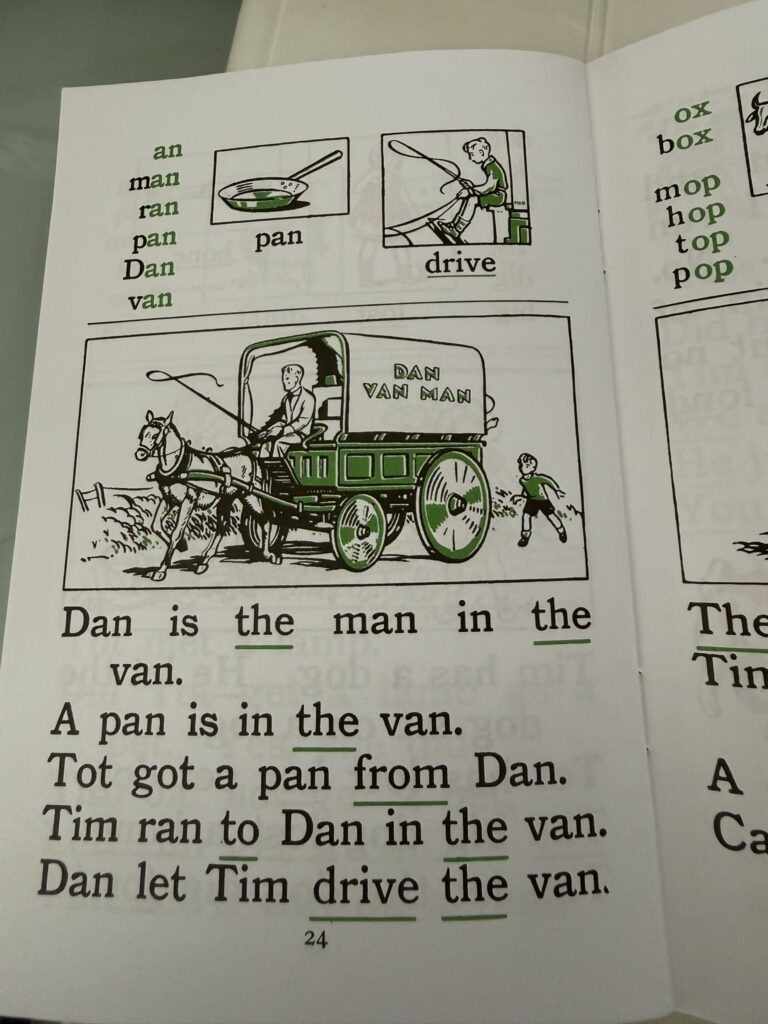
The song is the Mighty Sparrow’s spoof on the First Primer of Nelson’s West Indian Readers. The Readers, similar to “Dick and Jane,” were published by Oxford University Press, London, and used throughout Trinidad’s government schools.

The Mighty Sparrow’s calypso mocks both the childish idiocy of the lessons and the very adult idiocy of importing British-themed pedagogical materials into the colonies.

(Trinidad had won independence just one year before, under the leadership of Dr. Eric Williams. Williams was educated at Oxford; his thesis is the highly acclaimed history Capitalism and Slavery. His leadership was soon challenged by Trinidad’s Black Power Revolution, and Williams survived the challenge by endorsing Black Power.)

A few days ago I spent $8.95 on a copy of the First Primer. Opening it, it all seemed familiar. I must have used the First Primer when, at five, I attended first form at Las Lomas Government Primary School. I was the only white boy in the school. For some of the boys and girls my age, I may have been the first white person they’d ever met.

In the picture in the First Primer of Nelson’s West Indian Readers, Dan—the man in the van—is holding a whip over the back of a horse, which is pulling the wagon in which Dan sits. That is the “van” in the rhyme, not a motor van as we’d use the word now.

And Dan is white. In fact, all the people in all the illustrations in the First Primer of Nelson’s West Indian Readers are white.

So it is not surprising that the Mighty Sparrow would be making fun of the primers. In the song, he explains that he avoided idiocy by being too thick to learn the lessons. He sings:

How I happen to get some education
My friends, me ain’t know
All dey teach me is about Beer Rabbit
An’ Rumpelstilskin-o
Dey wanted to keep me down indeed
Dey try dey best, but didn’t succeed
You see, meh head was duncee
An’ up to now ah cyah read!

Dey beat me like ah dog to learn that in school
If me head was bright ah woulda be a damn fool!

With Dan, is de man, in de van

What am I to make of this childhood story?

Fifty years later, I was father to a 5-year old. I think 5-year-olds need to feel that they are accepted as an equal member of the group, so that they can build their sense of self through free interactions with peers.

And I’m not the man in the van. Never wanted to be, and never was.

1000 Hours of Meditation

As of this morning I have completed 1,000 hours of meditation, spread across 2,990 days. That’s an average of 20 minutes each day that I meditated.

This has been my habit: To meditate once each day, for 20 minutes, no matter what. Sometimes, it’s first thing in the morning or—even better—right after 30 minutes of yoga. But sometimes it’s been on BART, or an airplane. Or it’s the last thing in a long day, as I struggle to stay awake. Lately, I’ve sometimes meditated while charging the car.

It took me many years to attain this habit. My first inkling was the brief meditation accompanying savasana (corpse pose) during yoga classes 20 years ago. When my daughter was coming, her mom and I attended an 8-week mindful childbirthing and parenting class, adapted from John Kabat-Zinn’s Mindfulness Based Stress Reduction (MBSR) course. Our resolution to keep up daily meditation didn’t survive the first months of parenthood.

Six years later, my therapist suggested I take the 8-week course again, and I did. I installed the app Insight Timer on my phone. I followed it up the 8-week MBSR course with an advanced 10-week course a few months later. Returning to meditation practice helped me control my anxiety and intrusive thoughts. This time I continued to meditate after the course was done—but with spotty frequency and regularity.

In May 2018, I realized I had to face facts: Meditation practice was beneficial to me, but only if I committed to doing it regularly. And “committed to doing it regularly” meant every day, no matter what. Since then, I’ve missed a day here and there. I missed a day just last week, after a streak of 600 days. But aside from the (very) occasional miss, I’ve always put aside whatever else was going on so I could get in 20 minutes each 24 hours.

Almost all my sessions—like 97%, according to my Insight Timer data—are silent sitting meditation. I sit on a zafu (cushion) atop a zabuton (cushy mat). I put a couple of army blankets under the zafu so I’m up a little higher. The secret to a comfortable sitting meditation posture is to get your kneecaps slightly lower than your pelvis. Then, you can hold your back straight, and balance your big ol’ weighty skull on top, without having to fight the tightness in your hips and back. To get your kneecaps lower than your pelvis, you need to be up a little higher (if you’re tight in the hamstrings and hips and knees, like many of us are). I keep a block or a blanket handy on each side to support my knees. Usually, I slide these further away as my hips open up during the session.

For some sessions—every once in a while—I’ll go for a slow walk instead, and focus my attention on the soles of my feet for 20 minutes. It’s a good option if I haven’t moved all day, or if I need to get out of the house. And sometimes—especially when my concentration has been slack, or I’m feeling stuck—I’ll tap into one of the thousands of guided meditations on Insight Timer. Many of these guided meditations lean toward spacey new-age affirmations, which I don’t care for, but there are some really good ones, too.

One guided meditation in particular helped me improve my silent practice. In the 20-minute recording, the guide instructs you to direct your attention to your breathing and then to be attentive to the moment when your attention begins to drift into thought. The practice here is to watch the thought arise and make a conscious decision whether to follow it, or to return to the breath. It feels like exercising a muscle: At first, it seems very difficult to do consistently, but it becomes easier over time. Or that’s the claim. I still often find myself having followed a thought, despite my intention to consistently return to the breath.

In her book How to Meditate, Pema Chodron identifies five qualities that come forth over time spent in meditation:

  1. Steadfastness (loyalty to oneself, perseverance)
  2. Clarity (seeing what you do, self-awareness)
  3. Courage (to fully experience emotional discomfort and tribulations in life)
  4. Wakefulness (presence, being, relaxing with the unknown)
  5. Flexibility (all this is no big deal)

A thousand hours in, I feel that I’m just getting started on all of these. It’s been a good journey—not an easy journey, but one that has been rewarding in myriad ways, most of them ineffable. I’m certain my cerebral cortex is thicker for it, my cortisol levels lower. Mostly, I am grateful for my growing ability to return, at any time, to a place that feels like home.

Going to the “Hate America” rally

Tomorrow I’ll march at the “No Kings” demonstration in San Francisco. I hope you’ll be at one. There are many, many, many nationwide.

Your GOP neighbors—the ones with the flag decals on their car—consider these demonstrations to be “Hate America” rallies. So do the GOP politicians that the neighbors help elect.

Watch the neighbors, though. They are the ones who are going to turn you in.

I’m 67, and to me, this “you liberals hate America” business is old stuff. Nixon did it, and Reagan, and G.W. Bush. I miss the press being called “nattering nabobs of negativism.” On the other hand, “godless communist” spans all eras, and I’m just as good with that label now as I was then.

Your neighbors are right, you know. Many of us do hate America. We always have.

I’ve hated America since around the time I saw the pictures of people massacred at My Lai. For the record, that was when people started putting flag decals on their cars—because they wanted to show Lieutenant Calley that he was OK with them.

I know people who came back from that war hating America so much they’ve chosen to live their lives overseas.

To me, it rings hollow to say you hate only the bad part of America. Or that there is a good part of America. It rings hollow because the good part is only intentions and aspirations, and when you equivocate like that, what you’re doing is just stuffing the actual historical evil in a bag with those abstract aspirations and calling it a balanced view.

I’m not talking, here, about some abstract “America” and its role in the world, or about what the Declaration of Independence symbolizes. I’m talking about quotidian America, the real, everyday America. What it means to live a society that brutalizes children and animals, disdains empathy and intelligence, posits the individual as sacred—and then values that same individual only as an instrument of production, an object that makes money (or worse, a consumer, an object that spends money). That is the America my friends escaped, and that many of us have thought of escaping.

The America of the people with the flag decals on their cars.

If you want there to someday be some other America, some America where our children could grow up to be full human beings and not soulless producers and consumers, then you’ll have to start from scratch, almost. You’re certainly not alone in your desire. But trying to re-establish our now-wounded and always contingent liberal democracy doesn’t begin to cut it.

A better place to start might be by embracing a healthy hatred for everything that brought us to this juncture, on No Kings Day 2, October 18, 2025. Embrace your hatred for slavery and conquest—for the past that isn’t even past—and your hatred for capitalism, and for the racially exclusive and stratified nation the founders envisioned, and for what resulted from that, which is the only-sometimes-spoken belief in their innate superiority that afflicts white Americans and which defines all aspects of white American culture. The narcissism. The inability to grieve. The stunted and constrained lives we lead.

I suggest you also hate the cops, for this reason: Donald J. Trump ain’t original; he’s just inviting us all to act out the cop view of the world, a view that gins up our fears and then invites us to trade our freedoms for the illusion of protection—protection to be provided by authoritarians. A world view that valorizes brutality and suppression. This is why—take a moment to think about it—local, state, and Federal cops across the country supported Trump and continue to support him, even after they watched their brethren being beaten on January 6, 2021. Cop loyalty (the blue wall) is vaunted, but that loyalty pales in comparison to cop enthusiasm for fascism.

So yeah, hate America, for all the good and true reasons there are. This healthy hatred is only a start, but it’s a necessary start: To hate America and to grieve what it has wrought. From there can begin our journeys toward wholeness, both individual and collective.

Epstein and Ordinary Republicans

It seems inconsistent that there should be any fear, on the part of the Republicans, of the forthcoming revelation of what everybody already knows: Donald Trump was on Epstein’s plane, was going to Epstein’s parties, was raping children provided to him by Epstein.

Why would the revelation that Trump was raping children be of any concern to your typical Republican voter?

People who vote Republican don’t care about children and won’t sacrifice for them (as in want to pay the necessary taxes to provide for their care). They won’t protect them from labor exploitation or dangerous working conditions, provide them with medical care or a livable planet, or keep them from want.

But please, let’s not generalize or be unfair. There may be people who vote Republican who–while they lack concern for the victims of child rape–do in fact find it distasteful to associate themselves with the perpetrators of child rape.

Yet, for people who vote Republican, their favored candidates and politicians get a pass on just about any crime, from shooting someone on Fifth Avenue to massive corruption.

The question I’m interested in right now is: Why? Why is this hypocrisy so fundamental to the personal ethics and way of being of individuals who vote Republican?

Once again, my experience growing up in Chapel Hill, NC, in the 1960s, gives me a clue that will help make it clear.

That clue is white supremacy. Or rather the lie of white supremacy. Even more specifically, the shame of the lie of white supremacy.

This shame and lying was the the heritage, the baseline, the common thread, the fundamental organizational locus of Southern society during slavery. The lie and the shame continued into the Southern post-slavery society, and then, as migrants fled the ruined southern economy for other states, morphed into a Geist of its loyalists–that is, people who vote Republican–throughout the 50 states.

For people who vote Republican, the common daily act of perpetuating the lie, without admitting it or allowing it to be explicit, is the fundamental social currency. It is the underlying stuff that makes all other bits of social capital fungible. Shared whiteness is the common bond, the assumed common belief, the trust that makes transactions possible.

And Republicans’ affection for corruption, perversion, and performative cruelty is the guarantor of that trust.

How? Because the act of ignoring or condoning corruption, perversion, and performative cruelty is Republican solidarity itself. It is the way that people who vote Republican show their loyalty to each other and loyalty to the cause of defending white privilege.

The moral transgressions of the Republican elite are but grist for the mill–these transgressions are brought forth so that the everyday Republican voter can make a public show of defending the Republican elite with a recitation of what they know full well to be shameless lies and hypocrisy. (This includes castigating any opponents or defectors from the Republican fold as moral reprobates, in effect projecting the transgressions of their own heroes on to the opponents of white supremacy.)

Indeed, for people who vote Republican, the ability to be a shameless liar and hypocrite about rape and other forms of performative cruelty is qualifying. In the Republican social milieu, it is a favored ability, because it demonstrates the parallel ability to be a shameless liar and hypocrite about white supremacy. Among people who vote Republican, a personal performance as a shameless liar and hypocrite is, in fact, a bid for status.

This is what I learned growing up in Chapel Hill.

There is also, in that southern culture, a bent toward risky behavior–toward recklessness. Toward flirting with disaster. Playing with fire.

This drama-seeking love of risk is at play with the current iteration of the Epstein affair. Will the incontrovertible evidence finally be made public, and if it is made public, will it set off an avalanche of defections from MAGA? The manufactured excitement of this gambling diverts attention from the grief and terrible sadness of what was done to these children. It diverts attention from the moral emptiness of the elite perpetrators, and from the soullessness of each individual who votes Republican.

Abundance

Seems like the Mystic Camp owners scooped Ezra Klein’s hot new original ideas. By decades. Scarcity is a choice, let’s build! We’ll have an abundance of cabins if we don’t let those sticky flood regulations get in the way!

Why aren’t the “abundance” advocates elevating the camp owners as exemplars of Klein’s genius ideas?

Because, of course, Klein and the “abundance” advocates don’t mean needed safety regulations—the regulations that save lives—they mean the other regulations, you know, the regulations that we don’t need, that just get in the way.

Yes, there are plenty of stupid, arbitrary, unneeded regulations, but if you think it is easy to tell those regulations from the regulations that would have, if they had not been circumvented and overruled, kept those kids from washing away to their completely preventable deaths… think again. As I saw throughout my career as a civil and environmental engineer, the intensity of a belief that a regulation is not needed is generally proportionate to the believer’s ignorance.

She Wasn’t Getting Any Avocados

After waiting in traffic on the drive north, and stopping for groceries, we finally arrived at the river place at 7:30 PM. It’s midsummer, and the day still has some warmth to it, and I want to paddleboard upstream in the very last of the daylight. To have the flowing water and the redwoods and the warm sunset overwhelm and soothe my irritations with the world.

But there’s a stepladder. I notice it’s a nice new one. I can tell because the stickers on the side saying “Werner” are fresh; the bright construction-equipment yellow rail on the top is unsmudged. There are no splatters of paint on it, no dings or bent legs from past use. The stepladder looks lonely and left behind where it stands in front of my garage door.

I think I know why it’s there. The avocado tree that was just a bush, nine years ago when I bought the place, has now grown as high as the house. Last week, on the last trip up here, I’d noticed some plump avocados on its lower branches, which hang down above the garage door. Now they’re gone.

I stop the car in the dead-end street and get out. I walk over in front of the neighbor’s house, and look up above an imposing wood fence that makes the place look like a fortress compound. I see Renee, the matriarch of that family—the only one who is consistently sober—climbing the stairs.

“Hey there,” I call out. “Anybody missing a stepladder?”

“No.”

“You sure?”

“It’s not ours.”

“OK, I guess I’ll keep it.”

I move toward the task of opening the garage door. A stepladder will come in handy. Meanwhile, Renee is calling out a question to whoever might be inside the house.

“Anybody leave a stepladder outside?”

Somebody answers her. I can’t quite hear.

“Wait!” Renee yells at me. I stop.

“It is ours.”

I can hear her talking to whoever is inside.

“Why were you using the stepladder?”

A female voice answers her back: “I was getting some avocados.”

Soon a woman, 30s, hustles out of the gate, heads for the stepladder.

“Those are not your avocados,” I say to her.

“I wasn’t getting any avocados,” she says, closing the stepladder and hauling it back to her house.

Once you believe the lie of white supremacy and are really committed to that lie, then shamelessly believing and telling any other lie is just gravy. This truth is what unites Republicans across the economic spectrum in their behavior, in their loyalty to each other, and in their loyalty to their leader.

A Call for Radicalism

The onset of fascism makes us queasy and uncertain. Ready to question our working assumptions. This is a valuable time, an opportunity to shed illusions and gain fresh insights. It’s a time, I think, for renewed radicalism in thought and action.

Radicalism goes beyond the common emphasis on preserving our democracy as it exists, beyond calls to “unite the many; defeat the few.” There are good reasons for both of those strategies, but we shouldn’t limit ourselves to them.

By “radical,” I don’t mean strident or extreme. I mean far-reaching, thorough, “to the root.”

The following three touchstones indicate what I mean by “radical” thinking. They are not meant to be exclusive.

The first touchstone is the radical belief that all the wealth of society—that is, our collective infrastructure, possessions, and capabilities—are the product of society as a whole. All the value in the world was produced by the common and interconnected social effort of our forebears. The division of social wealth into private property is arbitrary and contingent. Private property came about via an historically specific process of appropriation—largely by force.

The second touchstone is that the world’s ills, including fraught relationships among nations, maldistribution of wealth and power, and crises of displacement and migration—that these ills arose from previous centuries of conquest, slavery, imperialism, and exploitation. To address the problems of humanity we must acknowledge this history and face up, morally and practically, to its present-day consequences.

The third touchstone is that society, at any and all scales, is ultimately created (and recreated daily) by human beings who have choices. At critical times in the past, people have chosen, collectively, to make radical changes in their way of social being. With that choice, change happens rapidly and inexorably.

By these touchstones, the order of the world is contingent, rather than necessary. The future is to be created, rather than endured. The response to fascism needn’t be limited to preserving the existing order, but can be aimed at bringing about a new one.

Fascist ideas, and fascists, are always with us. They gain currency, and power, when the existing order, and its institutions, seem unable to manage the process of change. Fascism’s claims are false—there is no immigration crisis, and crime is declining. However, underlying unease about the future is well-based and real. Big changes, radical changes, will be needed to cope with climate change, automation, and inequality.

Half measures seem inadequate, but half-measures have been the progressive consensus, as if to reassure ourselves that the real, acknowledged problems can be managed through existing institutions and processes—like Joe Biden’s American Rescue Plan, Bipartisan Infrastructure Law, and Inflation Reduction Act. That is, by expanding services and environmental protections, and increasing taxes on the rich to pay for them.

These common-sense half-measures would have added up to significant change over time, if they weren’t being reversed. However, the process of their adoption and implementation lacked the energy, vision, and disruptive influence that could make them feel radical—that would make them feel like collective action, make them feel like movement in the direction of a new order. And this lack of feeling, intention, movement, is what made it possible for Republicans to stop and reverse common-sense progress.

The idea among progressives seems to have been: Advance the policies, but pull your punches on expressing the ideology. Our policy proposals are mild, non-disruptive, common sense. Medicare for All. Universal Basic Income. Diversity, Equity, and Inclusion.

I’m saying: We should own our intention to transform society, to change the basis of the economy, to achieve freedom and plenty universally and worldwide, to make human beings the creators of their destiny. Our policies are mild and common-sense, and they could be put forward as the first steps to something far larger.

Let the Night Come

Here is a video of a staged reading of my play, Let the Night Come.

Synopsis: On a backpacking trip, four white men in their 60s share their losses of privilege, relevance, careers, and vitality. They witness changes to the wilderness and the global climate—and challenges to their common commitment to social justice. As they become lost and confront physical danger, they argue. What has to die here? What must be given up?

I first envisioned Let the Night Come in my tent during a summer 2022 backpacking trip on the John Muir Trail. I completed a first draft that fall, In my first semester in the Master of Fine Arts program at San Francisco State University, I later submitted it for inclusion in SFSU’s Greenhouse Festival of new plays. Through this collaboration between the Creative Writing and Theater Arts departments, I was connected with a director and actors to stage a reading, which was held on May 13, 2025 in “The Lab” theater at SFSU.