On May 4, 1970, I was 11 years old and in 7th grade in Chapel Hill, North Carolina. The previous fall, I’d been suspended for a week for selling the Protean Radish, the local underground newspaper, on the junior high school campus.
The massacre was a pivotal event in my childhood because it crystallized what I already knew: The adults that were in charge of me were not going to protect me and did not mean well for me. To the contrary, if I dared to tell the truths I knew, adults might respond with annihilating violence.
More to the point, people on “our side” were not going to stand up in the face this violence. Far from it. Caught between students’ revolutionary demand to overturn the racist and imperialist system on the one hand, and their children being shot down in front of them in the other, white liberals (and especially journalists, pundits, and philosophers) were going to equivocate.
This is the lesson of Kent State. White liberals, when they see their own children shot down, respond by crafting and repeating a narrative which equivocates between the killers and their own dead. The only faith white liberals have is to their own self-image as “reasonable people” who follow social norms, to their ongoing membership in the club of whiteness. This faith supersedes any commitment to truth.
I don’t need to detail the through-line from this state of affairs, in 1970, through the repeated stepping back in the face of each fascist advance 1980-2024, to the present fate of the United States. I saw the tragedy of liberalism then, and I’ve seen it play out since, over my lifetime.
The following is excerpted from my forthcoming memoir, “The Scapegoat’s Dilemma.”
I was feeling weak and sick sometimes. I’d get this burning in the pit of my stomach and then my chest and arms would feel like jello. When that happened I just wanted to go lie down. I started going to the refrigerator when the pain got bad. I’d pour myself a glass of milk and drink it down. Then I’d go back an hour or two later and drink another glass. It helped with the burning feeling, but not much and not for long. My mom got mad about me taking too much milk. I had to stop.
I was still distributing the Radish at school. I’d take a few of last week’s issue, or the week before, and pass them around. There was a lot to read and discuss. H. Rap Brown. Rioting and a bank bombing at UC-Santa Barbara. GIs assembling and documenting evidence of US atrocities in Vietnam. On International Women’s Day, the Radish’s center spread featured a joint statement “by six female liberation groups in Chapel Hill and Durham.”
Nixon had secretly ordered US troops to invade Cambodia, widening the ground war after a year of intensive bombing.
One Thursday afternoon my North Carolina History class was letting out, and I was the last to file out of the room. The last except for Mark Sloan. Mark’s dad owned Sloan’s Drugs down on Franklin Street. Something sharp hit me in the right kidney. “Communist,” Mark said. I bent over a desk in pain while Mark went around me, headed out of the room. I whirled around, took two steps, gave him a shove from behind. He lost his balance and crashed into a school desk. But he was bigger than me, and quicker, and soon had me in a headlock, smashing his fist into my right eye over and over. By the time he’d left, and I got to the classroom door, I couldn’t see out of it.
A teacher saw me staggering around the hallway and escorted me to the school office. My mom came, picked me up and drove me to the hospital. The X-rays came back negative—no fracture in the orbital—but I had blood in my eye for the next week. I stayed out of school until Monday. I went downtown and hawked the Radish.
You could feel the tension at UNC, the anger. Years of anti-war protests had amounted to nothing. In fact, every demand—for equality, for freedom, for peace, for human rights—had lead to more escalation, more repression, more vilification, more jailings, more frameups, more extrajudicial murders of activists. Many campuses were already on strike. UNC would soon follow.
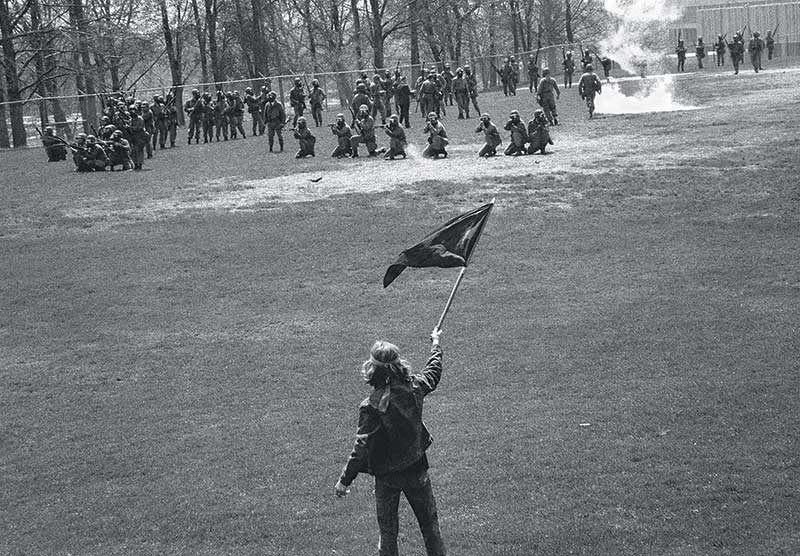
On Monday, May 4, I watched David Brinkley’s NBC News report of the National Guard’s action that day at Kent State University in Ohio. People running, tear gas, troops in formation, aiming, firing, ambulances. The next morning I went to Grey Culbreth as usual. The news had broken through the humdrum class routine of junior high school. It was on everyone’s mind. There wasn’t any outpouring of rage, or grief, or anything else. More like a numb confusion. Each teacher would try to say something cogent about it at the start of class, but it would come out like: We’ve all heard about this, and it’s terrible news. Now we need to focus on our lesson….
In the hallway, I heard a rumor that one teacher—known as a conservative hard-liner—had said, “It’s about time.”
I wasn’t surprised. Through my own daze, I could feel the verdict. Most Americans blamed the students for what happened at Kent State. David Brinkley had closed his report that night by repeating the official version—that the troops fired on the crowd only after student snipers fired on them.
NBC’s own news footage put the lie to that even before David Brinkley said it. We could all see it had been a massacre. The government had sent trained and heavily armed troops to deliver a message to the antiwar movement, to show us we could not expect to speak out against war, or challenge their authority, without being shot down defenseless where we stood.
The purpose of the lie was not to cover up the government’s responsibility. On the contrary, the purpose of the lie—and the purpose of leaving four students dead and nine injured—was to show that if the government chose to openly kill unarmed demonstrators, or activists, or radicals, whenever and whatever the circumstances, liberal reporters and commentators would say the truth was murky. That an investigation would take time. That both sides should de-escalate.
That center—the center of liberal moral equivocation—was going to hold. Crosby, Stills, Nash, and Young had their single about Kent State, “Four Dead in Ohio,” on the airwaves within a month. “Should’ve been done long ago,” the chorus went. Neil Young must have heard someone say the same thing I’d heard.
I can’t remember where I got the red flag. I think my sister Connie might have made it. She might have written “STRIKE” in wax on a piece of white bedsheet before mixing the jar of red Procion MX dye into a bucket of water and leaving the cloth in there overnight. The flag was stapled to a dowel, not too long, just a couple of feet, so you could hold it up and wave it. I was waving it around while biology class was getting seated. Mr. Killough told me to put it away. I didn’t.
Mr. Killough sent me to the principal’s office, but instead of going there I walked out the doors of the school and down the side of the highway toward town, waving my flag. On the UNC campus, the students were already out on strike. I was on strike too, now, and I’d never go back to school in Chapel Hill. If I had my way, I’d never go back to school at all.