So Colin Powell died, and among the inhabitants of our planet, for just a moment, there was one fewer cynical liars. Good.
Powell’s famed UN speech led directly to the disastrous US invasion and occupation of Iraq–and the death of hundreds of thousands of innocent Iraqis.
Later, he lied about his lying, blaming it on bad intelligence.
Crapola. For the occasion today I looked up what I wrote as I watched his speech that morning 18+ years ago.
. . .
February 5, 2003
I’m dubious about Truth. People talk about it the most when they’re giving you it the least.
Our grasp of what is depends, most of all, on the quality of the narrative we read to ourselves. Truth is a characteristic of language, of rhetoric.
I tried to apply this insight, this morning, as I watched Colin Powell on the TV. Where was Truth in the Secretary’s speech to the UN?
The murky photos marked with damning arrows. The mysterious fragments of wiretapped conversation. These seemed like dimestore props for the familiar rhetorical devices of a deceiver: escalating hyperbole, breathless speculation, and using the accused’s denial as further evidence of his guilt.
Add to this Powell’s science-fair speech about what can be done with just a teaspoon of anthrax.
And then there was the truck-mounted chemical weapons laboratory. Hans Blix says there’s no evidence that such a thing exists, but of course Channel 4’s reporters were soon breaking in to refer to Powell’s computer-generated images of the mocked-up model as “photos.” We’re led to conclude that the trucks could be out there, because, you know, they could be moving ’em around, the sneaky devils, and they haven’t shown us that they don’t have one.
I did sense, within all this foofahrah, bits of narrative that did ring True. Did the Iraqis clean up a little before the inspectors arrived? Who doesn’t? Of course, you want to show the inspector a clean site with nothing on it. Otherwise they just hang around and ask a bunch of questions, making you late to get home for dinner and potentially embarassing you in front of the boss. Anyone who’s operated an corporation yard or a commercial kitchen can relate to that story. I thought that part was True.
Or the tape of the two guys talking over on the phone. It’s got a bad connection, and they’re trying to make sure they got the instructions straight. It could have been an Abbott and Costello routine. So that seemed True as well.
Maybe these guys’ job is part of an evil plot to blow up the world. What I heard was, whatever they’re doing on the tapes or in the satellite photos, they’re doing it in the same confused chaos we all descend into every working day. That confusion and chaos and earnestness sounded real, and it contrasted, in my mind, with the ridiculous artifice of the U.S. Secretary of State.

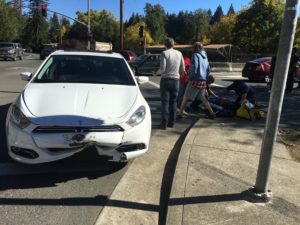 I stopped the bike, pulled my phone out of my jersey, and dialed 911. As the phone connected, a white Dodge sedan with front end damage pulled across the intersection and parked next to where I was standing, headed the wrong way. At the same time, the injured man got to his feet and staggered across the intersection toward me, then collapsed at the curb. A woman went to comfort him. I told the 911 operator a car had hit a pedestrian, who was seriously injured. I stayed on the line for a few minutes until a fire engine pulled up. People were out of their cars, gathering around.
 By this time, I’ve heard snippets of bystanders’ conversations, and I’m starting to put the pieces together. The injured man wasn’t a pedestrian, he was driving a motorcycle, which had smashed into the other side of the Volvo. But why?
 As I rode back through the intersection, on my way home, the driver was putting the ambulance in gear. I stopped for a look at the motorcycle and then pedaled home.